
 RSS Feed
Subscribe and receive email notifications of new blog posts.
27
Bend Oregon Inclusionary Zoning FAQ
Bend Oregon Inclusionary Zoning FAQ
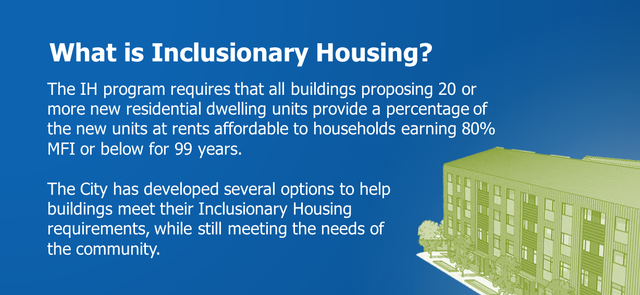
Definition
Inclusionaryzoning(or inclusionary housing as it is alsoknown)is a term which refers tomunicipal and county planningordinancesthat require a given share of newconstruction to be affordable forpeople with low to moderate incomes.
Issue Overview
Inclusionary Zoning is an impactful policy, the effects of which could be detrimental to central Oregon communities within thecontext of thecurrent affordable housing crisis. Price-controlling a designated amount of units within a specified area will ultimately result in the opposite of the desired effect –pricing out the middle-class buyer and creating a steep entrance into the housing market.
Until recently, a statutory preemption existed in Oregon which banned Inclusionary Zoning. However, during the 2016 short session, state lawmakers approved a package of housing legislation that included a bill which reverses the 17-year ban on Inclusionary Zoning. This bill –SB 1533B –provides the limited ability for cities to require somelarge multifamily developments, including workforce housing, if the city adopts the requiremen
What's in the bill?
Specific provisions of the bill include:
Requirements may be imposed on developments of 20 units or more of multifamily developments with at least three adjacent units within a development.
Jurisdictions may require that up to 20% of units be affordable at 80% of AMI or above. Jurisdictions must offer developers the option of paying an in-lieu fee, and at least one of several incentives related to the requirement of affordable housing. Requirements and incentives may be determined by each locality.
Communities may offer voluntary incentives designed to encourage affordability in addition to or independently of affordability requirements.SB 1533 also provides cities and counties with the option to create a dedicated revenue source through the imposition of a construction excise tax to offsetthe costs of creating affordable homes within their communities.Residential construction fees must be capped at 1% of permit value and 100% of revenues must be dedicated to affordable housing
The Loophole
A significant loophole currently exists in Inclusionary Zoning that extends the policy's reach in the case of annexation. The loophole essentially allows a city to require whatever amount of Inclusionary Zoning it desires when land is annexed into the city.
What's next?
The passage of SB 1533B and the subsequent lifting of the ban on Inclusionary Zoning gives Oregon cities the option to adopt Inclusionary Zoning policies. So it is now up to city councilsto determine whether or not –or to what degree –their city adopts Inclusionary Zoning policies.
COAR's Position
We recognize that compromise is necessary in order to pass legislation that addresses the affordability crisis while also protecting the interests of developers and REALTORS®. However, it is COAR's position that Inclusionary Zoning is a detrimental policy that will ultimately increase the price for homebuyers and decrease both the seller's bottom line and the supply of homes.COAR maintainsits opposition to Inclusionary Zoning and will oppose the efforts of any cities within itsjurisdiction that attempt to adopt Inclusionary Zoning as permitted by SB 1533B, as well attempts to extend the policy's reach through annexation
Resources
For more information on Inclusionary Zoning, reference the following resources:
Bento, A., Lowe, S., Knaap, G-J., & Chakraborty, A. (2009). Housing Market Effects of Inclusionary Zoning. Cityscape: A Journal of Policy Development and Research, vol. 11 (2). p. 7-26. -click here
High, A. (2016, February 21). Letter: Inclusionary zoning is not right for Bend. The Bulletin. Retrieved from http://www.bendbulletin.com/opinion/4006839-151/letter-inclusionary-zoning-is-not-right-for-bend
Means, T. & Stringham, E. P. (2012). Unintended or intended consequences? The effect of belowmarkethousing mandates on housing markets in California. Department of Economics, San Jose State University; School of Business and Economics, Fayetteville State University. -click here
Poverty & Race Research Action Council. (2014). Inclusionary Zoning: A Selected Annotated Bibliography. -click herePowell, B. & Stringham, E. (2005). The Economics of Inclusionary Zoning Reclaimed: How Effective are Price Controls? Florida State Law Review, vol. 33:471. p. 471-499. -click here
Schuetz, J., Meltzer, R., & Been, V. (2008). Silver Bullet or Trojan Horse? The Effects of Inclusionary Zoning on Local Housing Markets. Furman Center for Real Estate & Urban Policy. -click here
Theriault, D. C. (2016, March 17). Kate Brown signs bills on affordable housing rules, renter relief. The Oregonian. Retrieved from http://www.oregonlive.com/politics/index.ssf/2016/03/kate_brown_signs_bills_on_affo.html -click here
Article provided by: Central Oregon Association of Realtors (COAR)